
Dodge County Warrant Fallback Chain
No separate official Dodge County public active-warrant search page was located in the researched sheriff, court, or county sources. That changes the order of work. A person trying to verify a Dodge County warrant should not begin with a paid third-party list. The local fallback chain is the live jail roster, the Dodge County Sheriff's Office contact path, Magistrate Court for many arrest-warrant and first-appearance matters, Superior Court or the Clerk of Superior Court for bench warrants tied to felony, probation, or divorce/civil case files, and a municipal court when the matter began as a city traffic or ordinance citation.
The Dodge County Sheriff's Office contact page is the official sheriff route for questions that are not answered by the public jail roster. If the warrant may already have been served, the live roster is useful because the charge grid contains a Warrant# column. If the person is not in custody, that same roster is not proof that no warrant exists. A bench warrant may sit in a court file, while a traffic failure-to-appear warrant may stay with the court named on the citation.
The assigned warrant image comes from the sheriff contact source. The sheriff contact form source is the official online route identified for warrant questions when no public warrant database exists.
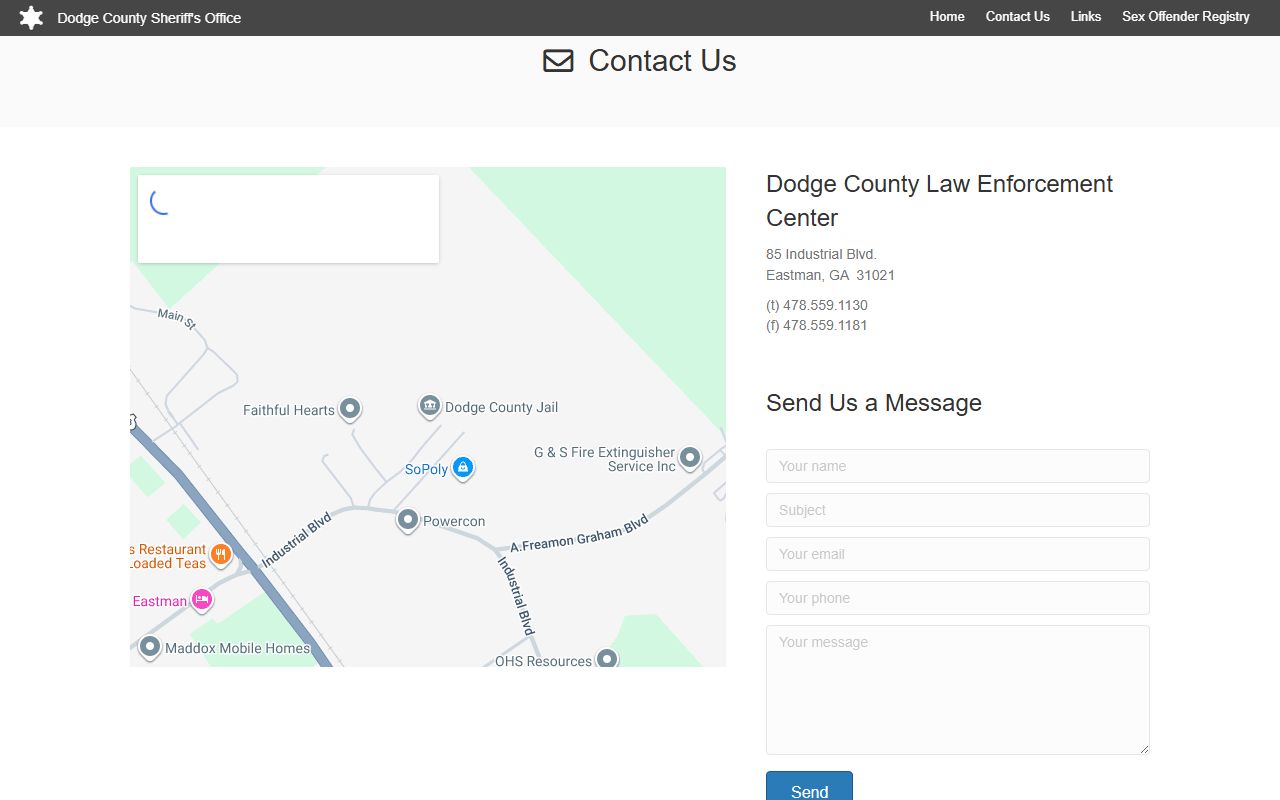
That source supports the main practical point for Dodge County warrant records: use official sheriff and court channels before acting on unofficial search results.
Dodge County Active Warrant Limits
Active warrant information is sensitive because it may involve officer safety, a sealed investigation, a juvenile matter, or a case that has not yet reached a public docket. The researched Dodge County sources did not show a public page that lists all active arrest warrants by name. The public item found in the sheriff ecosystem is the jail roster's charge grid, which can show a Warrant# column after a person is booked. That is different from a complete active-warrant lookup.
For many Dodge County warrant questions, the issuing court matters as much as the person's name. Magistrate Court is the likely local court for many arrest warrants, first appearances, preliminary hearings, and probable-cause steps. Superior Court handles felony case files, probation matters, divorce and civil files, and bench warrants connected to a pending or closed Superior Court case. Municipal Court can be the right place for city citations and traffic failure-to-appear matters. The state prison and federal inmate systems are custody systems, not local warrant databases.
Important: A clear jail roster search does not clear a Dodge County warrant; confirm with the issuing court or sheriff.
Dodge County Warrant Types
Warrant terms can overlap in normal speech, but the record source changes with the type of warrant. An arrest warrant authorizes law enforcement to take a person into custody. A bench warrant is issued by a judge, often after a missed hearing, missed payment, or court-order violation. A capias is a court order to take a person into custody and may appear in older or court-specific language. Search warrants are different because they authorize a search of a place or item, not a public name-based arrest lookup.
- Arrest warrant - often tied to Magistrate Court, a law-enforcement investigation, or an initial criminal accusation.
- Bench warrant - usually tied to failure to appear, probation, unpaid court obligations, or a case already before a judge.
- Traffic failure-to-appear - may stay with the municipal or other court printed on the citation.
- Search warrant - may remain sealed or unavailable while an investigation is active.
- Probation warrant - may connect to the Superior Court criminal case and later jail booking record.
Search Dodge County Warrant Records
The most useful public starting point is the live jail population tool linked from the sheriff site. The sheriff jail page embeds the Interop roster, and the roster can be searched by last name and first name. It also has current-inmate, 24-hour arrest, and arrest-date views. That roster helps when a warrant has already resulted in a booking, but it does not show every person with an outstanding Dodge County warrant.
- Check the Dodge County jail roster for current custody, recent arrests, and the charge grid.
- If the person is listed, review the charge fields, total bond, arresting agency, and any Warrant# entry shown in the grid.
- If the person is not listed, identify the likely court from the underlying event, such as Magistrate, Superior, or Municipal Court.
- Use the sheriff contact channel or the court phone line before appearing, paying, or assuming the warrant is inactive.
- After a warrant is resolved, confirm that both the court file and law-enforcement system have updated because clearance can lag.
Bench warrants tied to the Superior Court file may also require the Clerk of Superior Court or the Oconee Judicial Circuit case channel. Court case search access is login-gated in the researched sources, so a direct clerk request may be needed for certified court proof. For a charge that has become a full criminal case, the related file is discussed with Dodge County criminal court records.
Note: Do not rely on a private warrant-search site to decide whether to appear, pay, travel, or surrender.
Dodge County Warrant Search Fields
The warrant field table for Dodge County is really a jail-roster field table, because no stand-alone public warrant portal was found. The Warrant# column appears in the roster charge grid, but inspected sample cells were blank. Name fields can find people already booked into the jail. They do not search hidden, sealed, unserved, municipal, state, or federal warrant systems.
| Field Label | Type | Required | Notes |
|---|---|---|---|
| Warrant# | Roster charge column | No | Column exists in the charge grid; inspected sample cells were blank. |
| Last Name | Text | No | Can filter current inmates, but it is not a complete warrant search. |
| First Name | Text | No | Can narrow current inmate results when a person is already booked. |
| Current Inmates | Tab | No | Default custody list for people held at the time of search. |
| 24 Hours Arrests | Tab | No | Recent booking view, useful when a warrant may have just been served. |
| Inmates by Arrest Date | Tab | No | Arrest-date path for custody checks, not a full active-warrant database. |
Dodge County Warrant Field Inventory
When a warrant has led to a Dodge County jail booking, the public roster can show custody and charge details. The researched sample inventory showed name, booking status, sex, height, weight, address, arrest date, arresting agency, days in jail, total bond, and a charge grid. The grid includes Warrant#, Counts, Statute, Description, M/F, and Court. Some important fields were not visible in inspected current-inmate rows, including release date, pod or tank, and the judicial officer who set bond.
| Field | What It Shows |
|---|---|
| Name and status | Person listed in custody, with status such as currently booked. |
| Arrest date and agency | Date of arrest and agency text such as Dodge County SO or Eastman PD. |
| Total bond | Bond display, which may show an amount or a status such as not set. |
| Warrant# | Roster grid column for a warrant number when populated by the system. |
| Counts and statute | Number of counts and Georgia code or charge reference, when shown. |
| Description and M/F | Charge description and misdemeanor or felony marker. |
| Court | Court column exists, but inspected samples often had blank cells. |
Resolve Dodge County Warrants
Resolving a Dodge County warrant starts with confirmation, not payment through an unknown website. The person should identify the likely issuing court, call the sheriff or court with official contact details, and ask whether the warrant is active, whether bond is set, whether a walk-in docket exists, and whether an appearance is required. For traffic and municipal matters, ask whether online payment clears only the fine or also clears the warrant and DDS hold.
If an arrest occurs, use the jail roster to confirm the booking, charges, arresting agency, and bond status. Then use the court record to confirm what happened in the case. A jail charge is not the final court disposition. A court may dismiss, reduce, amend, or proceed on charges after the booking record appears.
Note: Voluntary appearance can still result in arrest, so legal advice is prudent before surrendering on a serious warrant.
Restricted Dodge County Warrant Records
Georgia public access rules do not make every warrant detail public. Open-records access under Georgia's Open Records Act applies to many agency records, but court records and law-enforcement records also have court rules, exemptions, sealing orders, and safety limits. Juvenile records, sealed criminal-history entries, adoption-related material, protected addresses, and sensitive personal identifiers are not treated like ordinary public records.
For Dodge County, that means a warrant may be real even when it is absent from the public roster. It also means a served warrant may appear only as part of a jail booking or case docket, while a sealed or restricted warrant may require party status, attorney authority, or a court order. When the warrant is tied to a Superior Court case, the Clerk of Superior Court is the record custodian for case-file copies, but law-enforcement confirmation still belongs with the sheriff or the issuing court.